


 biodata(at)ceitec.cz

Atomic Charge Calculator III
Atomic Charge Calculator III (ACC III) is an application for fast calculation of partial atomic charges. It features 20 empirical methods along with parameters from the literature. A short introduction covers the basic usage of ACC III. All methods and parameters are also available through a command-line application and a web API for use in user workflows. Read more in NAR.
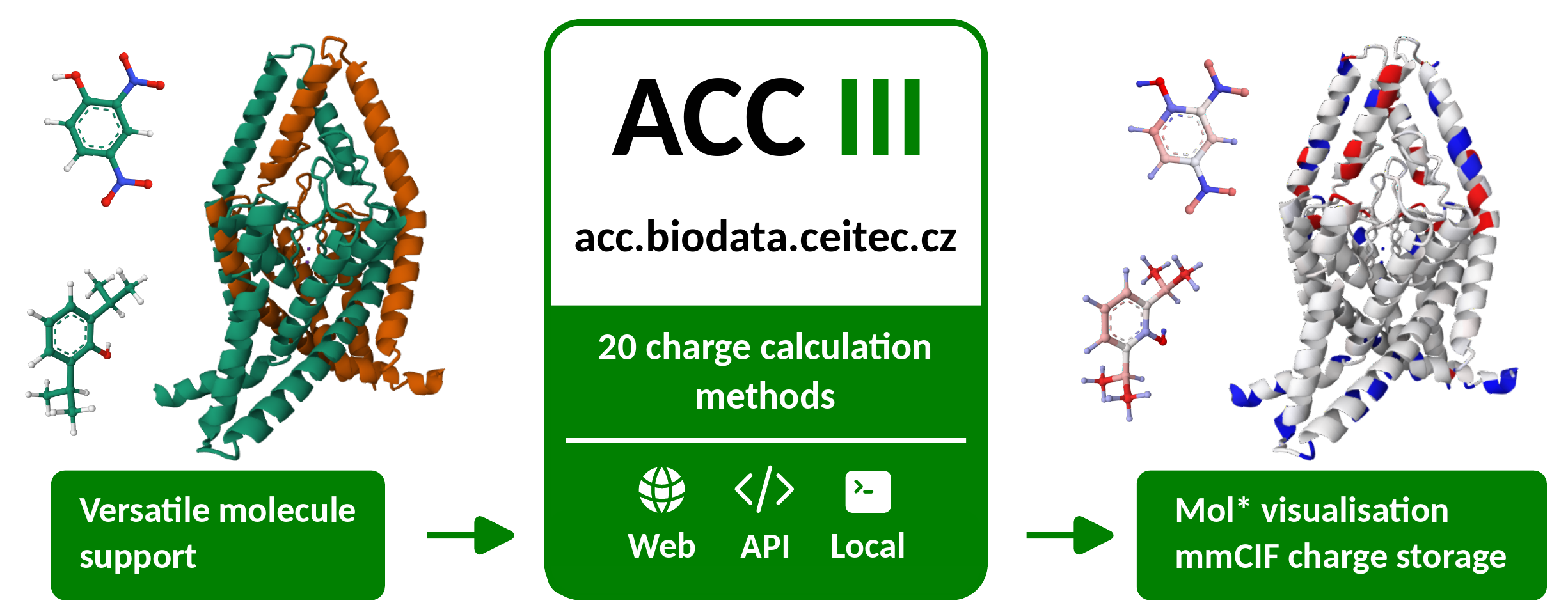
Partial atomic charges provide a simplified description of the molecular electrostatic distribution that governs interactions with the surrounding environment. Owing to their widespread use in computational chemistry, chemoinformatics, and bioinformatics, fast and reasonably accurate empirical approaches remain highly relevant. Here, we introduce Atomic Charge Calculator III (ACC III), a web application for computing partial atomic charges for diverse molecular systems, including small organic molecules and proteins. ACC III builds on previous releases and implements 20 widely used empirical charge calculation methods, including the state-of-the-art SQE+qp approach with updated parameters. The platform integrates the modern Mol* viewer for interactive visualisation and supports embedding computed charges directly into mmCIF files using a formally defined extension, enabling distribution of results in a community-standard, FAIR structural format. In addition to the web interface, ACC III provides a programmatic API for automated workflows and an enhanced command-line version for local deployment. The service is freely available at https://acc.biodata.ceitec.cz, with no login required, including for commercial use.
Examples
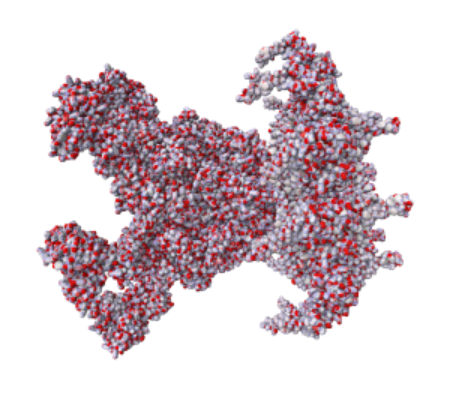
Pore complex
The SARS-CoV-2 pore complex (PDB ID 8yax) forms double-membrane vesicles to accommodate viral RNA synthesis and modifications [source]. Visualisation of partial charges on the surface highlights the difference between the nonpolar transmembrane region (mostly white due to charges near zero) and the polar surface of the extracellular and cytoplasmic regions (with a mosaic of blue positive and red negative charges).
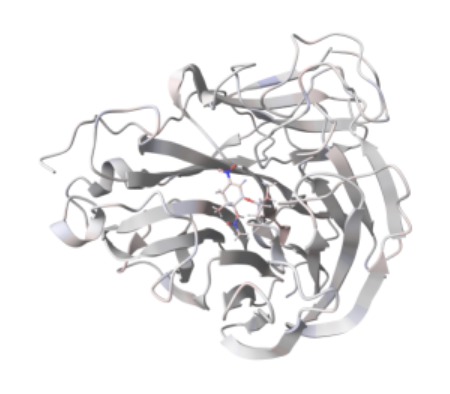
Neuraminidase in complex with oseltamivir
Oseltamivir, an antiviral drug known as TAMIFLU, binds to N1 neuraminidase from Influenza A virus (PDB ID 2hu4) [source]. Oseltamivir has a negatively charged carboxylate group that interacts electrostatically with positively charged arginines of the protein. Other functional groups of oseltamivir form additional electrostatic interactions, which further strengthen the bond between the drug and the protein.
Dissociating hydrogens
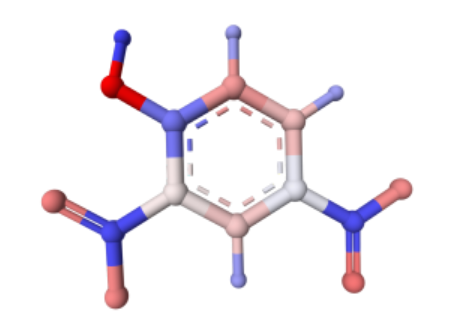
This example focuses on the acid dissociation of seven phenolic drugs, described in DrugBank. Their structures were obtained from PubChem. During acid dissociation, these compounds release a hydrogen from the phenolic OH group. Using ACC III, we can examine a relationship between pKa and the charge on the dissociating hydrogen. We found that the higher the pKa, the lower the hydrogen's charge (see table). This finding agrees with results published in the literature.